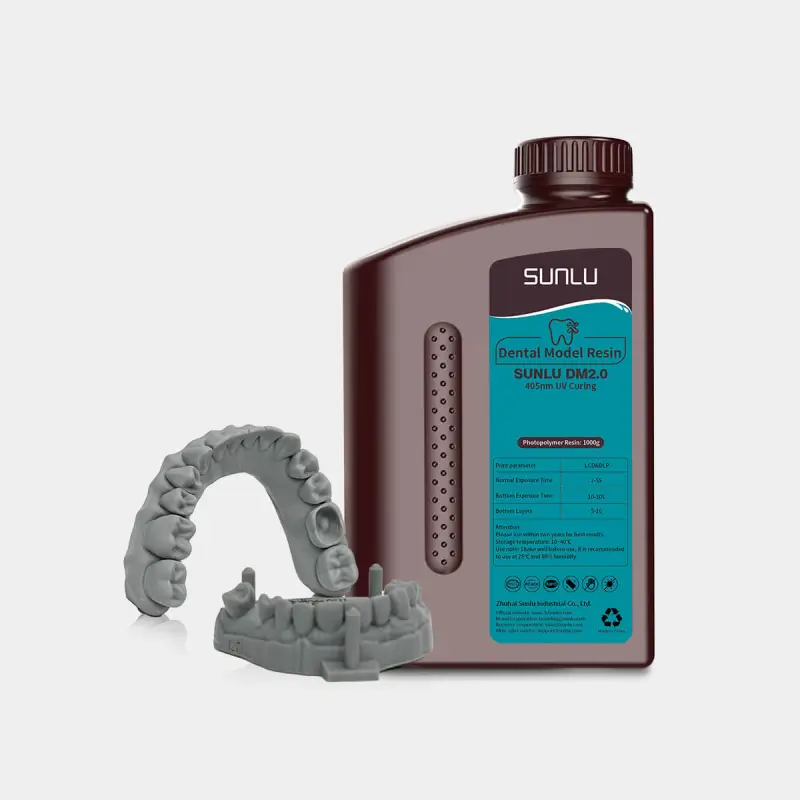
For businesses operating multiple resin 3D printers, purchasing material one bottle at a time can create unnecessary procurement work, inconsistent inventory levels, and avoidable shipping costs. Buying in larger quantities can simplify supply planning, but bulk purchasing requires more than comparing unit prices. Material compatibility, application requirements, packaging, storage, quality consistency, and supplier reliability all need to be evaluated before placing a larger order.
Start with the Printing Application
The first step in purchasing resin is identifying what the material needs to accomplish. Standard materials may be appropriate for general prototypes and models, while engineering applications can require greater toughness, rigidity, impact resistance, or dimensional stability. Dental, industrial, educational, and model-making operations may therefore have very different purchasing requirements.
For businesses practicing resin 3D printing at production scale, material selection should also correspond with the printer technology and established process parameters. A resin that performs well in one workflow may not deliver the same results when printing conditions, equipment, layer thickness, or exposure settings change.
Compare Resin Performance Before Price
Unit price is important, but it should not be the only purchasing metric. A lower-priced material can become more expensive if it produces frequent failed prints, requires extensive post-processing, or creates inconsistent results between batches.
When evaluating bulk resin, procurement teams should review characteristics such as dimensional stability, hardness, rigidity, toughness, flowability, odor, curing requirements, and recommended printing conditions. Technical documentation is particularly useful because it allows buyers to compare materials using defined specifications rather than relying only on promotional descriptions.
Calculate the Right Bulk Quantity
Buying more material does not automatically mean buying more efficiently. Businesses should estimate consumption according to printer utilization, average model weight, production schedules, and expected growth. Historical purchasing records can provide a practical baseline for determining how many kilograms should be ordered per cycle.
Storage capacity is another consideration. Resin should not simply be accumulated wherever warehouse space is available. SUNLU’s product guidance for its Dental Model Resin recommends storing the material sealed in a cool, dry place away from light, while also advising ventilation and protective equipment during use.
Check Packaging and Storage Requirements
Bulk procurement becomes more useful when packaging matches the customer’s consumption rate. Smaller individual containers can be convenient for controlled dispensing and inventory tracking, while larger quantities may reduce packaging and handling frequency. Buyers should confirm available package sizes before finalizing a purchasing plan.
Light exposure and storage conditions also deserve attention because photopolymer resins are light-sensitive materials. Properly controlled storage helps preserve material condition before use. Formlabs, for example, recommends keeping resin tanks covered and away from direct sunlight when stored.
Verify Supplier Consistency and Documentation
For recurring business orders, supplier consistency can be as important as the initial material specification. Procurement teams should ask whether the supplier provides technical documentation, safety documentation, recommended print settings, and identifiable product specifications. Consistent documentation makes it easier for operators to reproduce established workflows after replenishment.
A supplier with a broad material portfolio can also simplify procurement when different departments require different resin characteristics. SUNLU provides multiple resin categories, including standard, ABS-like, water-wash, high-precision, and functional materials, allowing buyers to match material selection to different printing objectives.
Consider Dental Model Applications
Dental laboratories and related businesses have particularly demanding requirements for model accuracy and stability. SUNLU Dental Model Resin is specified in a 1,000 g package and grey color on its current product page. The manufacturer states that the material maintains more than 80% dimensional accuracy after 15 days at room temperature.
The material is also designed around high hardness and rigidity, while its low-odor formulation and flowability are intended to support a more comfortable and stable printing process. These characteristics can be relevant when businesses need repeatable dental model production rather than occasional prototyping.
Build a Procurement Plan Around Actual Demand
A practical purchasing strategy should combine consumption forecasting with quality control. Businesses can begin by identifying their monthly material usage, preferred resin categories, printer compatibility, storage capacity, and acceptable safety stock. This information provides a more reliable basis for bulk ordering than simply selecting the largest available package.
For recurring resin 3D printing operations, buyers can also establish incoming inspection procedures. Checking packaging condition, product identification, batch information, and material appearance before distribution to production teams can help maintain internal consistency and simplify issue tracing when problems occur.
Make Bulk Buying Part of Supply Management
Bulk purchasing works best when it is treated as a supply-management decision rather than a simple volume discount. The most relevant factors include material suitability, predictable quality, packaging, storage, documentation, delivery reliability, and actual consumption. A clear procurement process can reduce interruptions while helping production teams maintain established printing workflows.
SUNLU offers a range of 3D printing materials for different application requirements, supported by product information and recommended printing guidance. For businesses considering bulk resin procurement, reviewing the intended application and material specifications before ordering can provide a more practical foundation for long-term purchasing decisions.
