Industrial thermal processes often depend on maintaining controlled and repeatable heat. Variations in gas supply, combustion air, pressure, or flame conditions can affect the temperature delivered to equipment. Manual burner adjustment may not respond quickly or consistently enough to manage those variables.
An automatic gas burner addresses this problem by integrating combustion regulation with monitoring and safety functions. Instead of treating ignition, fuel delivery, air supply, and flame supervision as separate manual tasks, the burner coordinates them as part of a controlled operating sequence.
Control Starts With Automatic Monitoring
Process control depends on knowing what is happening inside the combustion system. A gas burner therefore needs more than a fuel valve and ignition source when consistent industrial heating is required.
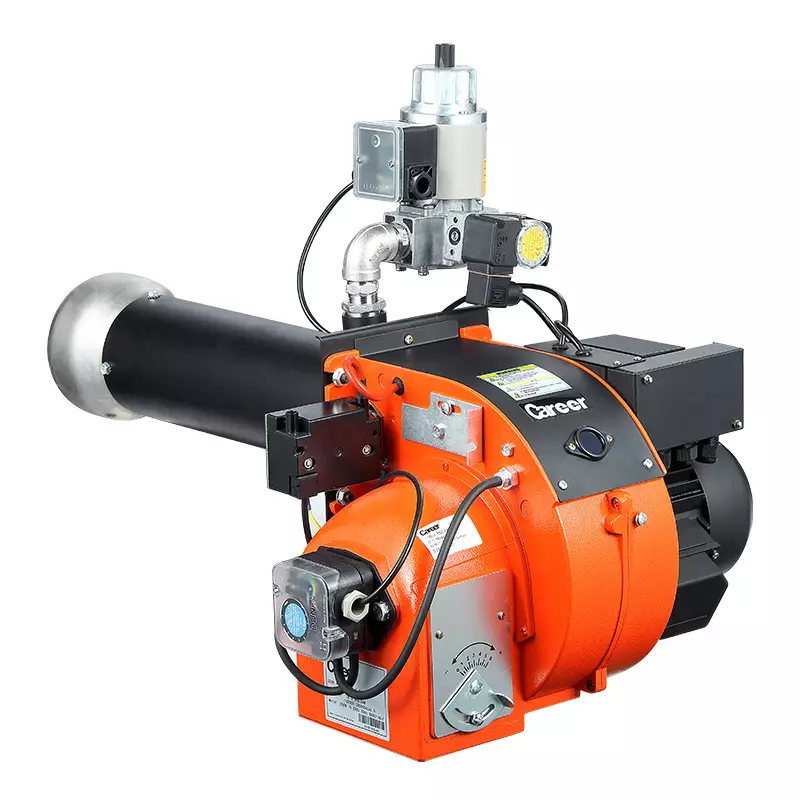
The GX25 combines automatic control with flame detection, air-pressure monitoring, and gas-pressure monitoring. These functions provide the control system with information about whether essential operating conditions are present before and during combustion.
Career Burner describes the GX25 as suitable for boilers, hot-water systems, industrial ovens, dryers, and food-processing equipment where consistent and controlled heat is required. Those applications can have different thermal demands, but all depend on reliable combustion conditions.
Monitoring is therefore the first layer of process control. The burner can respond according to defined operating conditions rather than relying entirely on an operator to identify changes and adjust the system manually.
Fuel-Air Regulation Stabilizes Heat Delivery
Gas combustion requires an appropriate relationship between fuel and combustion air. Changes in either side of that relationship can alter flame behavior and the resulting heat release.
The GX25 incorporates fuel-air regulation and accurate fuel-air ratio control. Its forced-draft air supply provides combustion air while the control system manages the relationship between air and gas.
For an industrial process, this matters because temperature control ultimately depends on predictable heat release. If fuel delivery changes without a corresponding adjustment in combustion air, or air conditions vary without appropriate fuel regulation, combustion can move away from the desired operating point.
An automatic system can coordinate these variables more consistently than a fixed manual setting. That makes the burner a more responsive part of the plant’s thermal control system.
Modulation Connects Burner Output to Process Demand
Heat requirements are not necessarily constant throughout a production cycle. Startup may require one firing condition, steady production another, and reduced-load operation a third.
The GX25 supports single- or multi-stage flame modulation, according to the product documentation. This gives the burner different ways to adjust heat release according to the control requirements of the installation.
A gas industrial burner with suitable modulation can therefore be integrated more closely with process demand. Rather than treating maximum firing as the default condition, the control strategy can use different operating stages where the application requires them.
Such control is particularly relevant to equipment where temperature must remain within a defined operating range. The burner becomes part of the response mechanism instead of functioning only as a heat source that is switched on or off.
Safety Controls Keep Combustion Within Operating Limits
Process control also includes preventing unsuitable combustion conditions. An industrial burner must establish and maintain the conditions required for safe operation before useful heat can be delivered.
The GX25 includes flame detection, air and gas pressure monitoring, and safety shut-off systems. These features are integrated into its automatic control system.
Flame detection, for example, provides supervision of the combustion state. Pressure monitoring addresses the availability of required air and gas conditions. Safety shut-off functions provide a means of stopping fuel supply when defined conditions are not satisfied.
Career Burner specifies these functions as part of the GX25’s automatic configuration, showing that process automation and combustion safety are closely connected rather than being independent functions.
Consistent Heat Improves Process Repeatability
Manufacturing processes often depend on repeatable thermal conditions. Drying, baking, heating, hot-water production, and boiler operation can all be affected when heat input changes unexpectedly.
An automatic gas burner supports repeatability by coordinating fuel delivery, air supply, flame supervision, and burner operation. The objective is not simply to automate ignition; it is to make combustion behavior more consistent during normal operation.
The GX25 is specified for natural gas and LPG and has a stated natural-gas consumption range of 12.0–25.0 m³/h, with output power listed at 118.4–270 kW. The manufacturer notes that actual parameters may vary with gas purity and concentration.
These figures also demonstrate why control must be considered alongside burner capacity. A process engineer needs to understand both the available firing range and the way the burner will be controlled within the thermal equipment.
What Automatic Control Changes in Practice
Automatic control improves industrial process control by turning combustion into a coordinated operating sequence. The burner monitors critical conditions, regulates the fuel-air relationship, adjusts firing according to its control configuration, and incorporates safety functions into the operating cycle.
By providing greater thermal consistency and minimizing manual intervention, a suitable industrial gas burner does more than just generate a flame—it becomes a core, active component of your process-control strategy.
The answer to the central question is therefore control integration. Automatic gas burners improve industrial process control because sensing, fuel-air regulation, modulation, flame supervision, and safety shut-off can operate together. When the burner is correctly matched to the process and its required heat load, this coordinated control provides a more predictable path from fuel input to the thermal conditions the production process requires.
